

Section 1
Introduction
Small businesses are widely underinsured. Many lack a broker who can understand their operations, search available markets, compare coverage and price, complete placement, and provide continuing service. Their risks matter no less than those of larger companies, but small commissions cannot fund the same attention. Traditional brokerage economics therefore ration service by account profitability even though the owner’s need does not shrink with the commission.
Kinro’s operational evidence comes from distinct snapshots and cohorts: placed customers, customer communications, and purchased leads. These samples do not share one verified three-month window or one buyer denominator. Figure 1 shows the result. Using the cost assumptions in Table 1 and a 50% contribution-margin target, a basic-service broker would need $444 in annual commission and would not have served about 90% of observed accounts for economic reasons; a high-touch broker would need $1,020 and would not have served at least 96%.
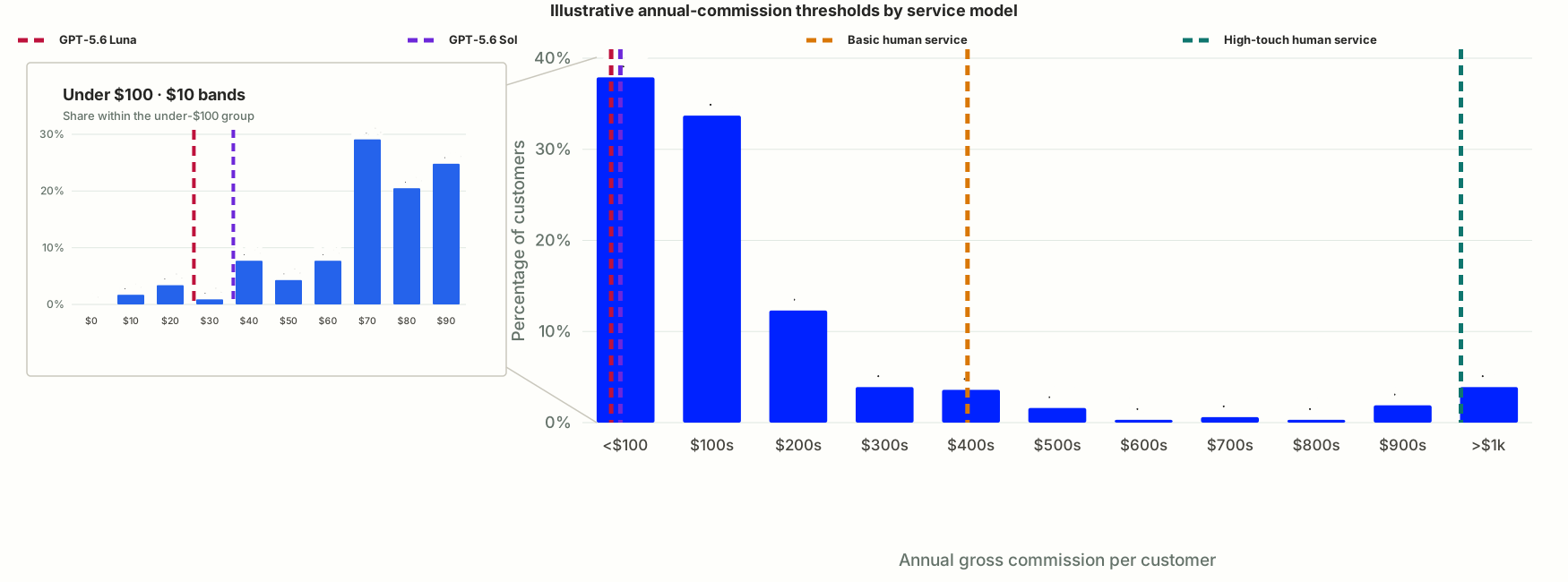
Kinro operational evidence. Annual gross commission per customer for policies Kinro placed during the previous three months. AI lines show annualized direct-cost break-even for GPT-5.6 Luna ($31) and Sol ($41), including $150 in non-compute acquisition spend per bound customer, full-funnel AI usage, and five years of service. Human lines show the commission required for a 50% contribution margin: $444 for basic service and $1,020 for high-touch service. The left panel expands the under-$100 band.
Kinro is a licensed insurance brokerage whose AI agents coordinate customer communication, intake, quote workflows, follow-up, and routine service. Because low-commission accounts can fund only a few human touchpoints, continuous service ultimately requires bounded autonomy: the system completes demonstrated work within explicit limits, while licensed professionals govern those limits and resolve unfamiliar or high-risk decisions. This does not authorize AI to independently perform every regulated act involved in selling, underwriting, or binding insurance. Those activities remain within the authority of the appropriate licensed brokerage, carrier, MGA, and professionals. Kinro remains accountable and liable for its standard of care and maintains E&O insurance against that risk.
Scope of this paper. This paper examines why high-quality brokerage service is economically unavailable to many small businesses and how a different service model could change those economics. It does not establish that AI can independently underwrite or price every risk, or that its effect on claims and loss ratios is already known. Underwriting quality, premium adequacy, and sustainable loss performance require separate evaluation with carriers and MGAs using submission, underwriting, pricing, and mature claims evidence.
This paper is intended for brokers, carriers, MGAs, wholesale markets, regulators, and consumer advocates. We invite them to form an industry-wide collective advancing safe, compliant AI-enabled brokerage that improves the customer experience, extends service to businesses unable to afford adequate help, and respects carrier appetite. Through bounded real-world pilots, the collective can establish common benchmarks, measure customer and underwriting outcomes, and determine when broader AI authority is warranted.
Section 2
Why small businesses are underserved
2.1
Owners have no insurance department
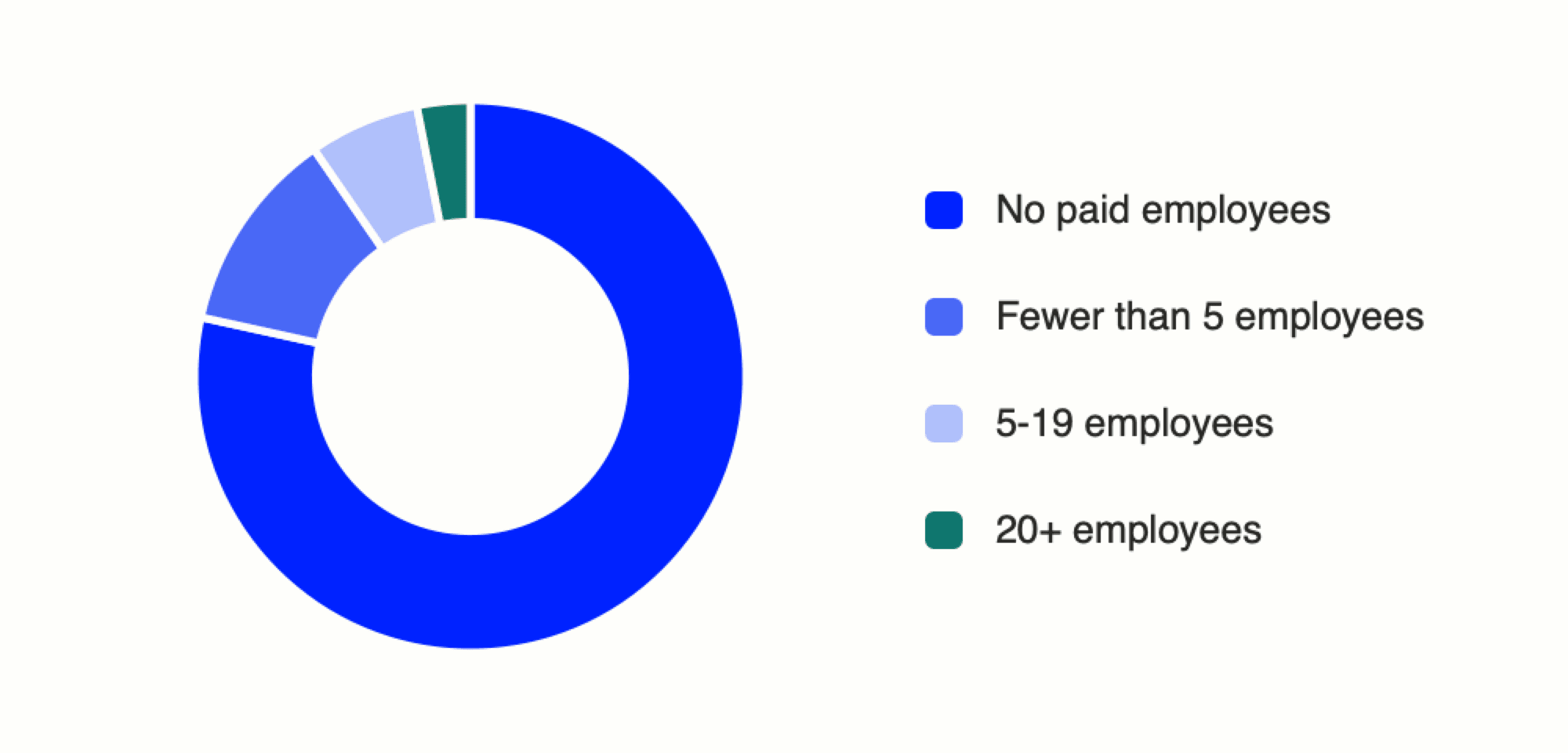
Public evidence. 90.4% of U.S. establishments had fewer than five paid employees in 2023: 35.07 million of 38.79 million.
Small-business owners have no department to hand problems to. They sell, operate, and fix whatever breaks, while payroll, taxes, contracts, and insurance keep demanding attention. Much of this work happens at night or on weekends, at the expense of family, rest, and health. Figure 5 later shows this pattern in Kinro’s operations: 51.1% of observed inbound customer messages arrived outside weekday business hours.
This is the typical business, not an edge case. In 2023, establishments with no paid employees made up 78.4% of all U.S. business establishments, and 90.4% had either no paid employees or fewer than five. These businesses also form an operating backbone beneath larger enterprises: owners supply goods and specialized services as vendors, contractors, and subcontractors. The federal contracting system makes this dependence explicit by requiring certain large prime contractors to create opportunities for small-business subcontractors. [20]
2.2
Small-business risk is highly heterogeneous
Small businesses are small in headcount, not simple or uniform in risk. The category spans restaurants, contractors, retailers, consultants, manufacturers, health practices, trucking companies, and thousands of other operating models. Each combines different premises, equipment, products, professional duties, vehicles, employees, contracts, and geographic exposures.
That heterogeneity makes understanding, classification, underwriting, pricing, and placement difficult to scale. A broker can specialize in one niche, but consistently acquiring only that niche is hard, especially when local demand is fragmented. A generalist must instead recognize many business models and carrier appetites while the revenue from any single small account remains limited.
2.3
Small businesses form a large insurance market
Their aggregate insurance market is substantial even though each account is small. Deloitte’s 2024 analysis estimates $32.8 billion in annual premium from 27.1 million nonemployer businesses and another $7.3 billion from 3.8 million businesses with one to four employees. Together, businesses with fewer than five paid employees represent an estimated $40.1 billion in annual premium across 30.9 million accounts. The four employee-size segments in Deloitte’s figure total $74.1 billion, effectively the report’s approximately $74 billion standard, non-specialty portion of a $113 billion under-50-employee commercial market. On that basis, under-five businesses generate about 54% of standard small-commercial premium while representing 94% of the businesses. [10]
The Census figure and Deloitte’s market estimate describe different units. An establishment is one physical business location; a firm may own several establishments. The 35.07 million establishments with fewer than five employees therefore cannot directly update Deloitte’s 30.9 million business accounts or its premium estimate. A newer market-size estimate requires comparable firm-level counts and explicit premium assumptions. [32]
2.4
Insurance becomes urgent before it becomes understood
Insurance is a consequential responsibility that few owners address on their own timetable. It often becomes urgent after a loss or close call, or when a customer, lender, landlord, or platform demands proof of coverage. The owner must then decide quickly, often without the knowledge needed to judge the options.
Insurance protects the business an owner has built by transferring losses it may not be able to absorb. Without suitable coverage, a single event can end the business. Property interruptions [23, 7, 13], liability claims [25, 18, 17, 16], workplace injuries [14, 21, 30, 29, 31], and cyberattacks [22, 9, 8] can consume working capital, halt operations, or create direct legal obligations.
Hiscox's 2025 survey[24] classified 77% of the participating US small businesses as underinsured and found widespread misunderstanding of what common policies cover. The broader protection gap takes two forms: no insurance at all, or insurance whose limits, exclusions, deductibles, or conditions do not match the losses the business could face.
2.5
Demand is growing as expertise declines
Figure 2 shows that the operating market is concentrated at the smallest end. Census application data also point to a growing pipeline of prospective businesses.
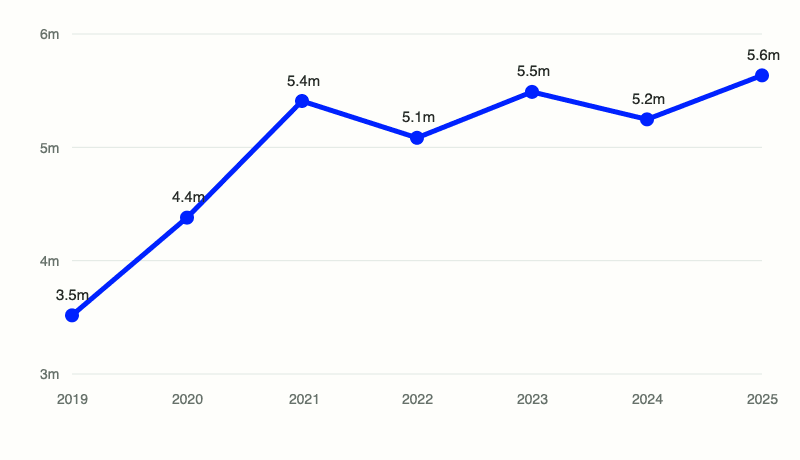
Public evidence. Applications rose 60.2%, from 3.52 million to 5.63 million. Census Business Formation Statistics count EIN applications, not confirmed businesses.
AI is likely to make some large organizations leaner while enabling smaller teams to perform work that once required more people. [3] Business-formation data reinforce the direction of travel: U.S. Census researchers found that AI-related applications rose beginning in 2012, accelerated after 2016, and jumped sharply in 2023; those applications were also more likely than other applications to become employer startups. [4] Together, the findings suggest that AI could increase the number of small businesses, and therefore the number of owners who must make insurance decisions.
Retirements also put hard-won expertise at risk. The Institutes reports that half of the current insurance workforce will retire by 2035, leaving more than 400,000 positions to replace. In its survey of risk-management and insurance professionals, 73% of respondents identified lost institutional knowledge as the retirement wave’s most significant effect. Expanding service therefore requires not only reaching more businesses, but preserving and transmitting the judgment of experienced professionals as they leave the workforce. [26]
2.6
Today's buying paths leave gaps
On their own. Owners may complete unfamiliar applications repeatedly, learning only at the end that a carrier will not insure their business. A single carrier’s answer does not establish the best available combination of price and coverage, yet owners are expected to identify appropriate markets and compare premiums, limits, exclusions, conditions, and product fit without the necessary expertise.
Through an agent or broker. Some owners find a broker who truly helps; others reach a seller representing one carrier, a broker with little time for a small account, or no advisor at all. Lead-generation systems can make the experience worse by distributing the same owner’s information to competing agencies without transferring the context already collected. The owner receives repeated calls, re-explains the business, resubmits documents, and restarts the application. What appears efficient to the distribution system becomes fragmented and exhausting for the customer.
The experience becomes even worse when the business has a hard-to-place risk.
With a hard-to-place risk. Standard carriers may decline unusual operations, while E&S placement often requires wholesale access, manual submissions, and specialist time that small premiums do not support. Figure 7 shows that carrier appetite, coverage, and product fit accounted for 27.0% of Kinro’s lost leads with a specific documented outcome. This is distinct from price competitiveness: the problem was whether an accessible market would write the risk or offer suitable terms. For a broker already expecting little revenue from the account, that added market search, wholesale coordination, and specialist work makes the risk even less economic to pursue, although the owner’s need for help is greater. These results document gaps in Kinro’s available placement routes, not proof that no insurer would write the risks.
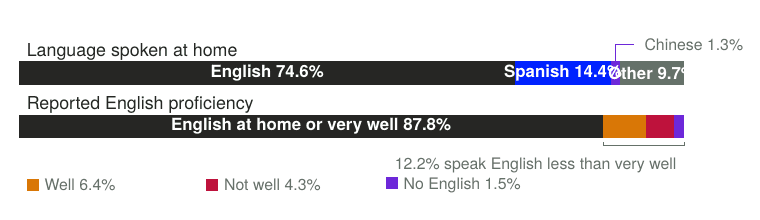
Public evidence. Language at home and English proficiency among self-employed Americans, 2022. 25.4% spoke a language other than English at home; Spanish accounted for 14.4% and Chinese for 1.3%. 12.2% spoke English less than very well, including 1.5% who spoke no English.
In a language they trust. Figure 4 shows that this need is not marginal: one in four self-employed Americans speaks a language other than English at home, and one in eight speaks English less than very well. Owners need a broker who can navigate English-language carrier systems while explaining consequential decisions in a language they trust. That support matters even more during servicing and claims, when carrier systems and internal teams may not support the customer’s preferred language.
2.7
Service must follow the owner’s operating rhythm and language
Continuous service must adapt to each owner's schedule, pace, and preferred language.
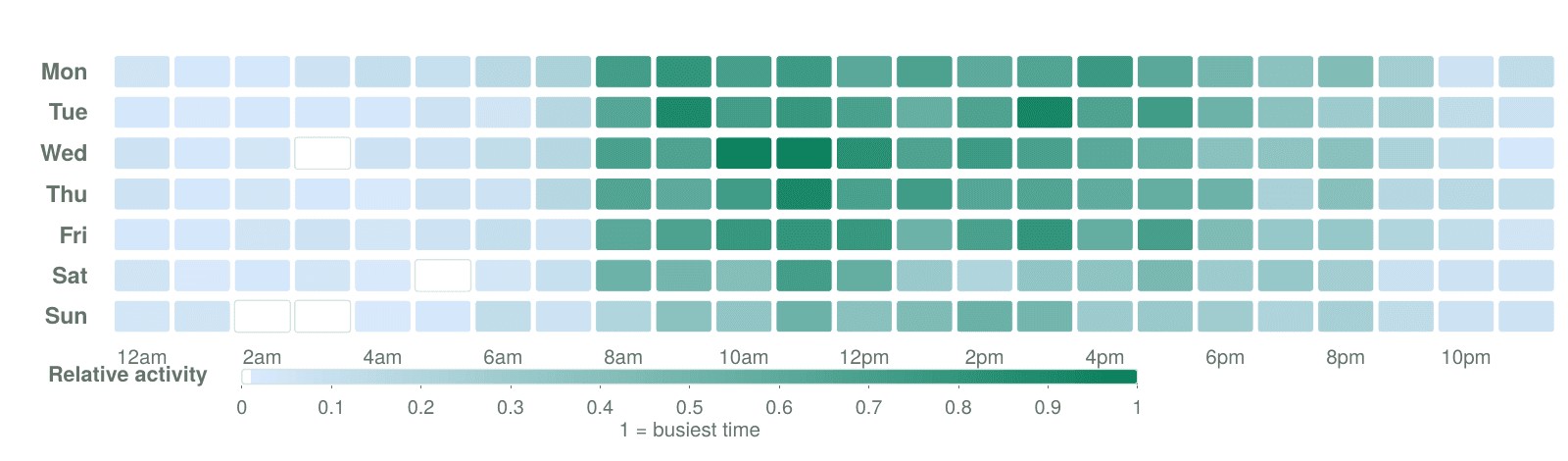
Kinro operational evidence. 51.1% of inbound customer messages occurred outside Monday–Friday, 9am–5pm in the lead’s local timezone. Test and simulated activity are excluded.
Customers from Hispanic and Chinese communities have asked Kinro to serve them in Spanish and Chinese, and Kinro has sold policies in both languages.
These customers are not asking merely for forms to be translated. They want to ask questions, understand tradeoffs, and complete the insurance process in a language they trust. A broker must also adapt to the operating rhythm of the owner’s business. An owner serving customers, supervising a jobsite, or moving between appointments may only be able to address insurance before the day starts, between jobs, or after closing.
Figure 5 shows that more than half of observed inbound messages arrived outside weekday business hours. Availability at those times is therefore not a convenience; it is part of serving owners on the schedules their businesses allow. The chart aggregates businesses and does not estimate industry-specific schedules, but it demonstrates why brokerage service cannot be designed only around the broker’s office hours.
Channel preference also varies: some owners prefer SMS, some prefer email, and some prefer phone calls. A broker must meet each customer in the channel they prefer and preserve context when the conversation moves between channels.
Insurance work also moves at different tempos. Figure 6 shows a sample of 60 customers divided into three time-to-bind batches: less than one day, one to seven days, and eight to thirty days.
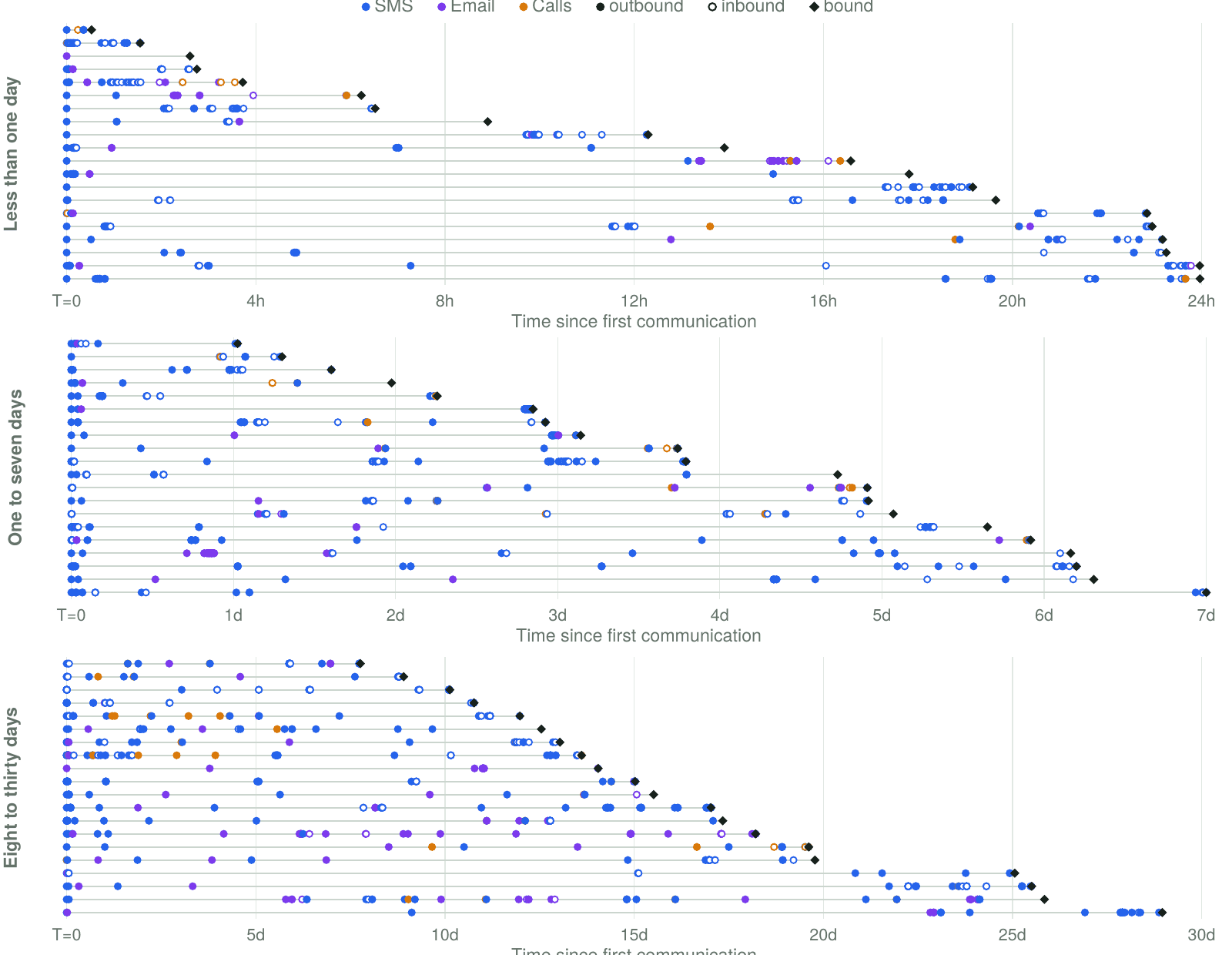
Kinro operational evidence. Paths from first contact to first policy bind for a sample of 60 customers on different timelines. The three panels show customers who bound in less than one day, one to seven days, and eight to thirty days. Each row represents one customer, and each panel uses its own time scale.
The underlying business need can be immediate, such as satisfying a contract or certificate deadline, or unfold as an owner gathers payroll, vehicle, location, and prior coverage information around daily operations. Each panel uses its own time scale. These durations begin with the first recorded SMS, email, or answered call; they do not represent continuous time spent buying insurance or isolate the effect of business type.
Figure 6 makes a second point: outbound work often continues after the customer has replied. Persistence can reassure owners that the broker is still working for them and keep insurance from disappearing behind the many other demands on their day. Because the figure shows a sample of customers who ultimately bound, it does not prove that follow-up caused the sale or that any one industry follows a particular timeline. It does show why the service must preserve context, resume across interruptions, and maintain reliable outbound follow-up at the pace each owner can sustain.
2.8
Small-account economics limit service
Small-business policies generate small commissions despite requiring sales, advice, placement, and service. A $600 policy at a 15% commission yields $90 a year, yet still requires market search, certificates, renewals, and answers. Table 1 compares a high-touch broker, a basic-service broker, and AI-enabled service priced with GPT-5.6 Sol and Luna across a five-year relationship. Section 4 explains the assumptions.
| Customer work over five years | High-touch broker | Basic-service broker | GPT-5.6 Sol | GPT-5.6 Luna |
|---|---|---|---|---|
| Sales and initial placement | 10h ($400) | 8h ($320) | $12.00 | $0.64 |
| Four annual renewals | 8h ($320) | 4h ($160) | $7.20 | $0.38 |
| Quarterly proactive market checks | 20h ($800) | 0h ($0) | $28.80 | $1.54 |
| Proactive customer check-ins | 10h ($400) | 0h ($0) | $2.40 | $0.13 |
| Certificates, routine service, and one claim | 12h ($480) | 12h ($480) | $2.40 | $0.13 |
| Five years for one customer | 60h ($2,400) | 24h ($960) | $52.80 | $2.82 |
Kinro’s three-month placement cohort shows how concentrated those economics are at the low end. 71.5% generate less than $200 in annual gross commission and 83.8% generate less than $300. These figures aggregate placed policies for each customer and measure gross carrier commission before any producer payout.
The basic-service and high-touch broker thresholds in Figure 1 represent an illustrative 50% contribution-margin target before fixed overhead. Each requires revenue equal to twice modeled direct cost, including the assumed $150 acquisition cost. The AI-enabled thresholds are bare direct-cost break-even: five-year model usage plus $150 in acquisition cost, divided across five years. That is approximately $41 annually with GPT-5.6 Sol and $31 with GPT-5.6 Luna. None of the four lines is an observed broker acceptance cutoff, and the 50% human-service target is a scenario rather than an estimate of a universal required margin.
Within customers below $100, the distribution is concentrated near the top of the range: 74.4% generate $70–<$100.
The commission chart intentionally shows only the distribution of revenue. The AI input- and output-token assumptions used to compare service models remain in Appendix A.
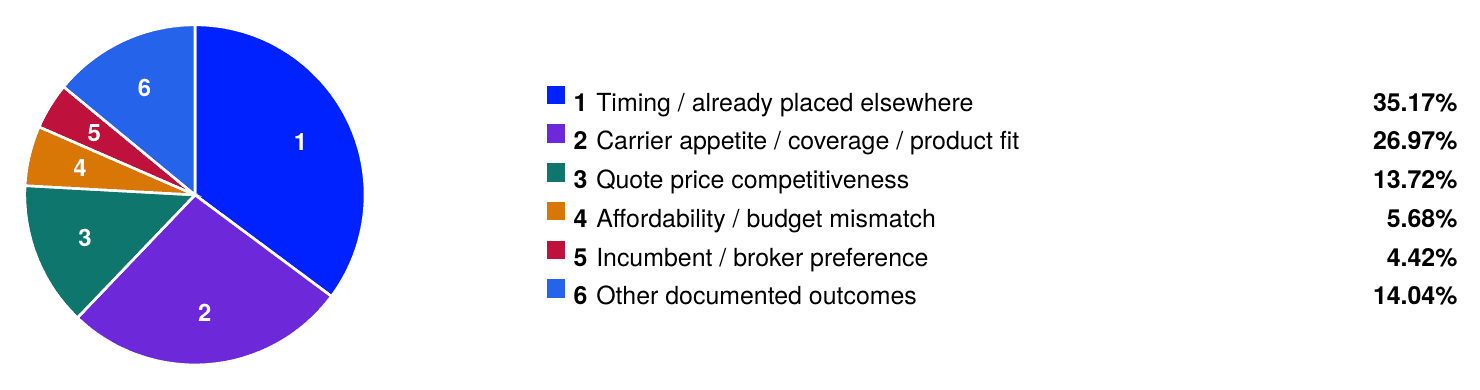
Kinro operational evidence. Documented outcomes among a selected subset of lost purchased leads. The denominator is 634 of 1,217 lost leads; 401 no-response cases and 182 general declines are excluded. Five included classifications remain flagged for human review. “Timing / already placed elsewhere” includes purchases elsewhere plus explicit slowness or missed deadlines; it signals urgency but does not establish causal delay. Snapshot: September 14, 2026.
Figure 7 also shows why speed matters. Among lost leads with a specific documented outcome, 35.2% had already placed coverage elsewhere or explicitly cited slowness. Only 3.2% explicitly documented lateness or a missed deadline, so the figure does not establish that delay caused the remaining losses. It does show that the opportunity to help an owner can close quickly, making reliable follow-up and timely market search part of the required service.
Section 3
What an exceptional broker owes the buyer
An exceptional broker removes insurance from the owner’s workload without taking away control. The broker understands the business, gives buyer-side advice, completes authorized work, and remains accountable for the result.
Although “agent” and “broker” are used loosely and legal roles can vary by transaction, the principle here is simple: advice should begin with the buyer’s needs and compare suitable options across the markets the brokerage can access. Sometimes the right recommendation is to keep the existing policy, buy less coverage, consult a specialist, or not complete a sale.
That responsibility spans the entire relationship. Before the sale, the broker must understand the business, explain the choices, search accessible markets, and verify placement. After the sale, the broker must retain context, service the policy, help with claims, and reassess coverage as the business changes. Table 1 models the cost of providing that attention at each stage.
Exceptional service means receiving the right help at the right moment, engaging on one’s own terms, never having to repeat context, remaining in control of consequential decisions, and seeing each issue through to completion. Its standard is the quality and continuity of customer protection, not merely policies sold or tasks processed.
No person can remain continuously available, remember every unfinished thread, and follow up reliably across an unlimited number of accounts. Human experts therefore teach, evaluate, and govern the system while resolving bounded exceptions. Universal service becomes economically possible as demonstrated routine capabilities cease to require transaction-level human review.
Section 4
How AI changes small-account economics
Consider an illustrative lawn-care business that pays $600 in annual premium and remains a customer for five policy years. The model assumes that the carrier pays the brokerage a recurring 15% commission while the policy remains in force: $90 each year, or $450 over five years. Actual commission schedules vary. Table 1 compares the modeled direct cost of acquiring and serving that one customer through initial placement, four renewals, and five years of service.
Table 1 follows the placed customer through renewal and service, but its sales and initial-placement row accounts for the entire sales funnel. It allocates across each bound customer the work performed for prospects who do not ultimately purchase, as well as the education, follow-up, market search, quote comparison, payment confirmation, and verification required to complete a successful placement. The 10-hour high-touch and 8-hour basic-service allowances are illustrative planning inputs, not a rounding of the observed full-funnel snapshot. Human labor is valued at $40 per hour. The AI model-usage columns are planning scenarios, not observed five-year production averages. They price the same assumed language-model input and output used as AI agents read customer context and documents, reason about the next step, draft and explain responses, monitor follow-up, review market or policy information, and perform supported routine service. It excludes software development, infrastructure, carrier and vendor fees, licensing, governance, and human escalations. Appendix A.2 documents the token and pricing assumptions.
The mismatch is immediate: the account generates $450 in five-year commission, compared with $960 for a basic-service broker and $2,400 for a high-touch broker. Modeled AI usage costs $52.80 with GPT-5.6 Sol and $2.82 with GPT-5.6 Luna. These are direct-cost comparisons rather than complete brokerage economics: licensing, compliance, infrastructure, management, expert governance, and profit must still be funded.
The human-touchpoint budget below retains GPT-5.6 Sol as the more conservative model-cost case. Every bounded decision or exception escalated by the AI system adds human labor and delay. At 15 minutes per resolution and $40 per hour, each human touchpoint costs $10. Figure 8 shows the five-year budget for the $90 annual-commission example. It makes the economic constraint visible: bare break-even leaves $247.20 for 24.7 touchpoints but no contribution margin. Once half of revenue is reserved as contribution, only $22.20 remains for escalation, or about 2.2 touchpoints over five years.
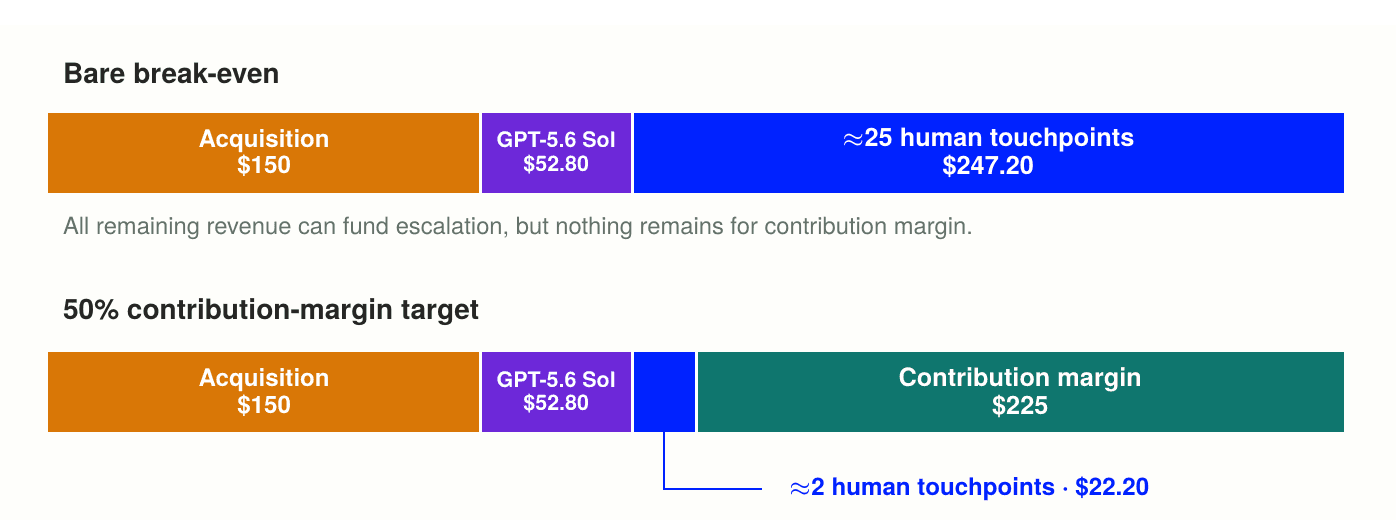
Illustrative model. Five-year revenue from a $90 annual-commission account: $450. At a 50% contribution-margin target, modeled acquisition and GPT-5.6 Sol usage costs leave room for only about two 15-minute human escalations. A high-touch broker costs $2,400, or 5.3× this account’s five-year revenue. Fixed overhead, governance, and licensing are excluded.
A high-touch broker in Table 1 uses 60 hours, equivalent to 240 fifteen-minute units. The goal is not to reproduce those hours as human escalations. It is to deliver the same or better customer outcome primarily through AI agents while reserving scarce expert time for the decisions that truly require it.
Lower cost creates the possibility of universal service; it does not prove that the service is good. Autonomous authority should expand only when evidence shows that the brokerage can apply insurance knowledge to a particular business, respect customer permission, complete the work, and produce a verified outcome.
Lower distribution cost cannot come at the expense of underwriting quality. Even when carriers or MGAs retain authority over underwriting and pricing, an AI-mediated sales process can affect loss performance through the accuracy of risk classification, the completeness of submissions, and the mix of business presented. Evaluation must therefore pair conversion, speed, cost, and customer experience with submission quality, underwriting corrections and referrals, and pricing adequacy.
Claims and loss ratios provide essential downstream evidence, but they mature slowly and are influenced by pricing, geography, catastrophe exposure, and business mix. Early evaluations should measure leading indicators such as material-fact completeness, classification accuracy, underwriter corrections, and referral or decline rates. Claims frequency, severity, and loss-ratio outcomes should be compared as credible cohorts mature.
Section 5
Conclusion and industry agenda
Every small business should be able to obtain appropriate coverage and competent continuing help. Yet the smallest policies rarely generate enough commission to support the patience, education, continuity, and availability owners need through human labor alone.
AI creates an opportunity to change those economics by sustaining communication, memory, follow-through, and routine work across the customer relationship. Human experts must continue to govern consequential decisions, and the licensed brokerage must remain legally and financially accountable for every outcome.
Realizing that opportunity safely requires brokers, carriers, MGAs, wholesale markets, regulators, and consumer advocates to build a shared evidence base through bounded real-world pilots, common benchmarks, and measurement of both customer and underwriting outcomes.
| Industry participant | How they can help |
|---|---|
| Brokers | Identify tasks AI could perform if proven sufficiently accurate; contribute demonstrations, corrections, specialty knowledge, and customer context; and define when qualified professionals must intervene. |
| Carriers, MGAs, and wholesale markets | Make appetite, coverage terms, information requirements, and servicing rules understandable and accessible; provide structured feedback on submission quality, underwriting decisions, pricing, claims, and loss performance. |
| Regulators | Define requirements for disclosure, authorization, accountability, monitoring, incident response, and remedies; create evidence-based paths from bounded pilots to broader authority. |
| Consumer advocates | Ensure benchmarks and deployment standards reflect small-business owners’ needs, including clarity, accessibility, control, correction, and fair outcomes. |
Success would mean that every business receives exceptional insurance service.
Section 6
About Kinro
Kinro is a commercial insurance brokerage licensed in all 50 U.S. states and offering most major lines of commercial insurance. Our goal is to provide the best customer experience in the market to the long tail of businesses this paper describes.
Across the team, our insurance experience spans serving micro-premium accounts and building insurance products and risk models from the managing general agent side of the industry. Our technical experience includes building safety-critical systems for autonomous driving at Zoox and training AI models at Google DeepMind to be more educational and capable in finance.
Contributions and Acknowledgments
Contributions
The entire Kinro team contributed to this paper:
- Pierre-Alexandre Kamienny
- Parthasarathi Ainampudi
- Corentin Hugot
- Hemanth Sai Kosari
- Robert Martin
- Armand Bechy
Acknowledgments
We are grateful to Jonathan Crystal and Stephen McGovern of Crystal Venture Partners, and to Bill Cecil, for generously sharing their time and expertise in reviewing this paper.
References
Section Appendix A
Five-year human and AI workload assumptions
Appendix A.1
Commission-distribution cohort and threshold construction
Figure 1 uses a production snapshot as of September 13, 2026. Percentages use non-test customers with policies Kinro placed during the previous three months and complete commission-rate data. Gross commission is measured before producer payout. The plotted AI-enabled thresholds sum five-year GPT-5.6 Sol or Luna usage and the assumed $150 acquisition cost, then divide by five years to show direct-cost break-even. The basic-service and high-touch broker thresholds double the sum of five-year direct cost and acquisition cost, then divide by five years to show a 50% contribution-margin target. All four exclude fixed overhead, infrastructure, and expert review; the broker-service target is a contribution margin, not a modeled net-profit margin.
The model follows one bound customer through five policy years while allocating the work of the entire sales funnel across that customer. The five-year horizon is an expected customer lifetime assumption, not an observed Kinro retention result. Under a constant annual churn model, a five-year expected lifetime implies 20% annual churn and 80% annual retention (1/0.20=5). At that rate, 40.96% of customers would be expected to reach the fifth policy year (0.8^{4}). The table uses the five-year expected lifetime as a single planning case rather than probability-weighting each policy year. Its assumptions combine an externally benchmarked labor rate, workload estimates grounded in workflows Kinro has observed, and explicit service-design choices about cadence and depth. They are planning estimates, not industry-wide averages or formal time-and-motion measurements.
The 10-hour high-touch and 8-hour basic-service sales allowances and the $150 acquisition allowance are illustrative planning inputs, not measured cohort averages. The separate September 13, 2026 open-funnel snapshot contains 4,426 purchased leads and 119 bound customers: 1,479.63 modeled human-equivalent hours allocate to 12.43 hours per bound customer, and $43,120 in recorded source spend allocates to $362.35 per bound customer. That snapshot is a lower-bound workload estimate and an open-funnel cost allocation, not a mature-cohort CAC or observed employee time.
The $40 rate is a rounded national, cross-state economic-cost proxy, not a uniform wage. The U.S. Bureau of Labor Statistics reports median 2025 pay of $61,550 for insurance sales agents in agencies and brokerages, or about $29.60 per hour over 2,080 hours, including commissions and bonuses but excluding self-employed owners[28]. BLS also reports that benefits were 30% of private-industry employer compensation in June 2026[27]. Applying that broad benefit share implies roughly $42 per hour, so the model retains $40 as a conservative assumption rather than claiming false precision. Actual cost varies by state, role, utilization, and compensation plan. Producer pay is often a share of agency commission; the $40 therefore values time and should not be added again where the same producer compensation is already counted.
| Component | Great | Minimal | Basis |
|---|---|---|---|
| Sales and initial placement | 10h | 8h | Illustrative full-funnel planning allowances per bound customer, not a rounding of the observed snapshot. It includes conversations and follow-up with prospects who do not purchase, plus education, market search, payment confirmation, comparison, and verified bind for successful placements. The basic-service broker spends less market-search time. |
| Four annual renewals | 8h | 4h | Kinro planning estimate: two hours per renewal for the high-touch broker and one hour for the basic-service broker. |
| Certificates and routine service | 10h | 10h | Kinro planning estimate: two hours per policy year for certificates, changes, payment follow-up, and routine care. |
| Proactive customer check-ins | 10h | 0h | High-touch broker design choice: two hours per policy year. The basic-service broker is reactive. |
| Proactive market checks | 20h | 0h | High-touch broker design choice: four one-hour checks per year for five years. The basic-service broker does not proactively rescan. |
| Claims assistance | 2h | 2h | Scenario assumption: one claim in five years and two hours to explain, report or coordinate, and follow up. |
| Total | 60h ($2,400) | 24h ($960) | Labor valued at $40 per hour. Compliance is not included as a separate workload component. |
Appendix A.2
Human-touchpoint affordability assumptions
Figure 8 presents the $90 annual-commission case using the same five-year customer-lifecycle model as Table 1. Before human escalation, the conservative GPT-5.6 Sol case has modeled AI-enabled direct cost of $202.80: $150 for acquisition and $52.80 for model usage. Each human touchpoint is assigned 15 minutes and valued at $10 using the same $40 hourly rate. For annual commission c, the bare break-even capacity is \max(0,(5c-202.80)/10) touchpoints. Reserving 50% of revenue as contribution margin limits modeled direct cost to the other half and reduces capacity to \max(0,(2.5c-202.80)/10). At $90 in annual commission, the results are 24.72 and 2.22 touchpoints. Figure 9 extends the comparison across annual commission levels. This planning model excludes fixed overhead, governance, and licensing; actual escalations occur in whole units and may take more or less than 15 minutes.
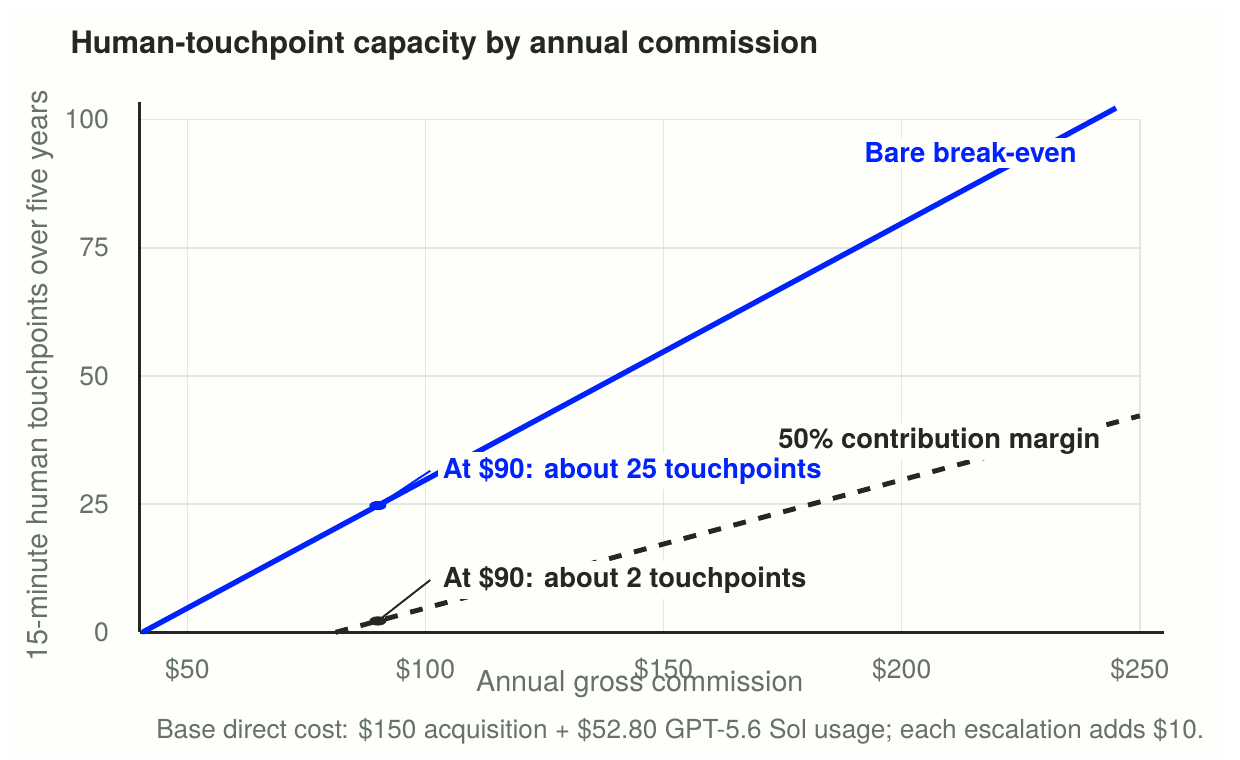
Illustrative sensitivity analysis. Maximum 15-minute human touchpoints over five years under bare break-even (solid) and a 50% contribution-margin target (dashed).
Appendix A.3
AI model-usage assumptions
The $52.80 Sol and $2.82 Luna estimates are illustrative model usage, not measured production averages or the full cost of AI-enabled service. GPT-5.6 Sol costs $4 per million input tokens and $20 per million output tokens; GPT-5.6 Luna costs $0.20 and $1.20, respectively.[12, 11] Both cases retain the main table’s allowances: 2.0 million input and 200,000 output tokens for initial placement; 1.2 million and 120,000 for renewals; 4.8 million and 480,000 for proactive market checks; 400,000 and 40,000 for customer check-ins; and 400,000 and 40,000 for certificates, routine service, and one claim. The five-year total is 8.8 million input and 880,000 output tokens. These estimates exclude development, infrastructure, carrier and vendor fees, licensing, governance, and human escalation.