
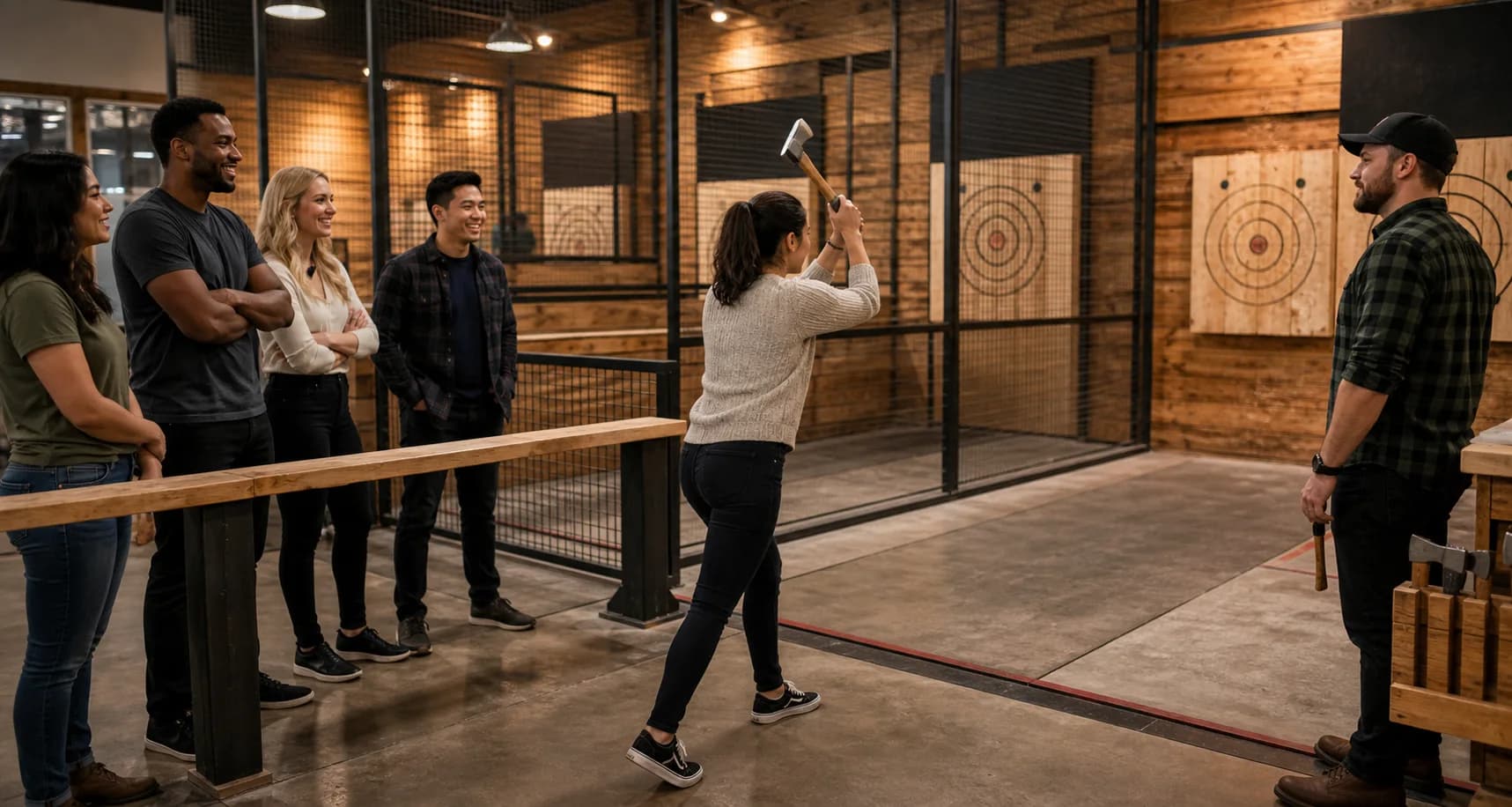
Participant exclusions
Confirm how the policy treats customers while they are actively throwing, not only spectators and premises visitors.
Built for U.S. small businesses
Compare coverage for fixed venues, mobile events, participants, alcohol, employees, and equipment.
Find coverage in about 2 minutes
Prefer to talk?
The central coverage question
The biggest gap may be hidden in an exclusion or limitation—not on the declarations page. These are four details worth checking before comparing price.
Confirm how the policy treats customers while they are actively throwing, not only spectators and premises visitors.
A fixed-location policy may not follow a mobile setup to breweries, festivals, company events, or private property.
Alcohol sales, service, and BYOB are different exposures and should each be disclosed and addressed explicitly.
Occurrence and claims-made forms respond differently, and a lease may specify the form and limits it accepts.
Start with the operation
A storefront, a trailer, and a venue with several attractions can reach different carriers and require different policy terms.
Participant and spectator injuries, lease requirements, tenant buildout, business interruption, coaches, food, and alcohol.
Off-premises liability, trailers, towing vehicles, equipment in transit, enclosure design, and event contracts.
Axe throwing combined with rage rooms, escape rooms, laser tag, archery, food service, or other entertainment.
Alcohol sales, service, and bring-your-own-beverage rules can create different liability and underwriting questions.
Ready to see your options?
Start with your ZIP · response within 2 minutes
Build the coverage stack
Requirements depend on the operation, state, lease, contracts, and underwriting. These are the common areas to evaluate together.
Covered customer, spectator, premises, and third-party property-damage claims.
Review: Confirm axe-throwing participants are included and the operation is accurately described.
Eligible medical expenses following a covered participant accident.
Review: Consider it alongside liability coverage; it is not a replacement for general liability.
Covered damage to the building, buildout, contents, and resulting interruption.
Review: Check replacement values, lease responsibilities, waiting periods, and covered causes of loss.
Eligible employee injuries and occupational illnesses.
Review: Review state requirements, payroll, employee duties, and mobile-event work.
Covered allegations arising from selling or serving alcohol.
Review: Tell the agent separately about alcohol sales, service, and BYOB.
Covered mobile equipment losses and business vehicle liability or damage.
Review: Review trailers, towing vehicles, employee vehicles, transit, storage, and event setups.
Covered claims that exhaust an underlying policy limit.
Review: Confirm it follows the axe-throwing, mobile, and alcohol coverages that matter to the business.
Before you buy or renew
A low premium does not resolve a restriction that conflicts with the operation, lease, or event contract.
Real-world scenarios
A bounce-back, missed throw, slip, or lane-control mistake leads to an injury claim involving a customer or spectator.
Your trailer, targets, axes, or enclosure are damaged in transit, or your setup causes damage at an event location.
Your venue sells or serves alcohol, allows BYOB, or faces an allegation involving an intoxicated guest.
Fire, water, or another covered event damages the buildout and interrupts operations during a busy period.
A coach or other employee is injured while demonstrating a throw, maintaining a lane, or moving equipment.
Knife throwing, rage rooms, escape rooms, laser tag, archery, or other activities create exposures beyond axe throwing.
Examples are illustrative. Whether a policy responds depends on the facts of the claim and the policy’s terms, conditions, and exclusions.
Prepare a stronger submission
Clear operating details help an underwriter understand the business and reduce avoidable back-and-forth.
Pricing
There is no responsible one-price estimate for every venue. Carriers may rate separate activities and revenue streams differently, then apply their own eligibility and minimum premium rules.
Ready to see your options?
Start with your ZIP · response within 2 minutes
Opening or expanding
Start before signing a lease or event contract. Kinro can help identify likely insurance requirements and the information underwriters will request.
Discuss a new operationAlready insured
Review participant treatment, occurrence versus claims-made wording, mobile operations, alcohol, limits, and how the policy aligns with the lease.
Start a policy reviewShare the location, mobile work, alcohol, activities, and basic business details.
A licensed agent can focus on participant treatment, exclusions, contracts, and market appetite.
Review coverage structure, limits, carrier terms, and price before deciding.
No obligation. Availability, coverage, and pricing depend on underwriting and policy terms.
Questions owners ask
Not automatically. Policy wording varies, and some forms can restrict or exclude injuries to people participating in the activity. Ask for a policy-form review that specifically confirms how axe-throwing participants are treated.
No. A well-drafted and consistently collected waiver can be an important risk-control tool, but it does not prevent every claim or replace insurance. Have an attorney familiar with your state review the waiver.
New ventures may be eligible, but carriers commonly want a detailed description of the venue, lane design, supervision, training, waivers, participant ages, alcohol, projected revenue, and any additional attractions.
Potentially. The policy must contemplate off-premises operations. Underwriters may ask about the trailer, target and enclosure design, setup controls, event types, towing vehicles, storage, supervision, and participant separation.
General liability is not a substitute for physical-damage coverage on a trailer or equipment. Commercial auto, trailer coverage, and inland marine may all need to be evaluated based on ownership and use.
BYOB should always be disclosed and reviewed explicitly. The appropriate coverage depends on state law, how the venue controls alcohol, and the policy wording. Do not assume a general liability policy automatically handles BYOB incidents.
Lease requirements vary, but landlords commonly specify general liability limits, additional-insured status, certificates, property responsibilities, and sometimes umbrella coverage. Review the insurance section before signing or renewing the lease.
An occurrence policy generally looks to when the covered injury or damage happened. A claims-made policy generally depends on when a claim is first made and requires attention to retroactive dates and continuous coverage. Your lease may specify which form it accepts.
Following recognized operating and safety standards can help explain your controls, but it does not guarantee eligibility, pricing, or coverage. Tell the agent which standards, training, and competition rules you actually follow.
Possibly, but every activity needs to be disclosed. Knife throwing, archery, rage rooms, escape rooms, laser tag, food service, and other attractions can change carrier eligibility, pricing, exclusions, and required controls.
Carriers may consider revenue by activity, participant volume, fixed versus mobile operations, alcohol, additional attractions, property values, payroll, limits, location, and claims history. Final pricing is determined through underwriting.
Yes. Share the relevant requirements or policy documents, and Kinro can help identify questions about limits, participant treatment, mobile operations, alcohol, and other terms that deserve review.
Timing depends on having active coverage and complete certificate-holder requirements. Once coverage is in force, Kinro can help process eligible certificate requests and flag requests that require carrier approval or a policy change.
Ready to see your options?
Start with your ZIP · response within 2 minutes
We make shopping for insurance simple, fast and transparent.