
Insurance Industry · November 9, 2026
Why E&S Is a Proving Ground for Accountable AI: Kinro x Pathpoint
How live market requirements, customer context, and clear responsibilities can support AI brokerage.

A broker can obtain a quote by making a business easier to describe. The harder job is to make the business accurately understood.
That distinction matters in E&S. A contractor can perform several kinds of work, use subcontractors, accept unusual contracts, or operate in places that change the available coverage. Those details determine the questions to ask and the markets to approach. Removing them from the description can make an application easier to complete while making the insurance less appropriate.
AI creates an opportunity to reduce the work of preserving that detail. It can organize conversations and documents, ask follow-up questions, and carry a file through successive market requirements. It can also make an incomplete description look persuasive and repeat the same mistake across many accounts.
Kinro’s work with Pathpoint connects two complementary capabilities: a brokerage carrying customer context and distribution, and a wholesaler providing E&S market access, requirements, and specialist expertise. The technical question is how to preserve the risk and responsibilities as AI carries more of the work between them.
For a conversational brokerage, work can begin across the customer’s preferred communication channels. The customer conversation and underwriting correspondence need to feed a consistent brokerage record. Market requirements determine which fact to resolve next; the next answer may change what the market needs.
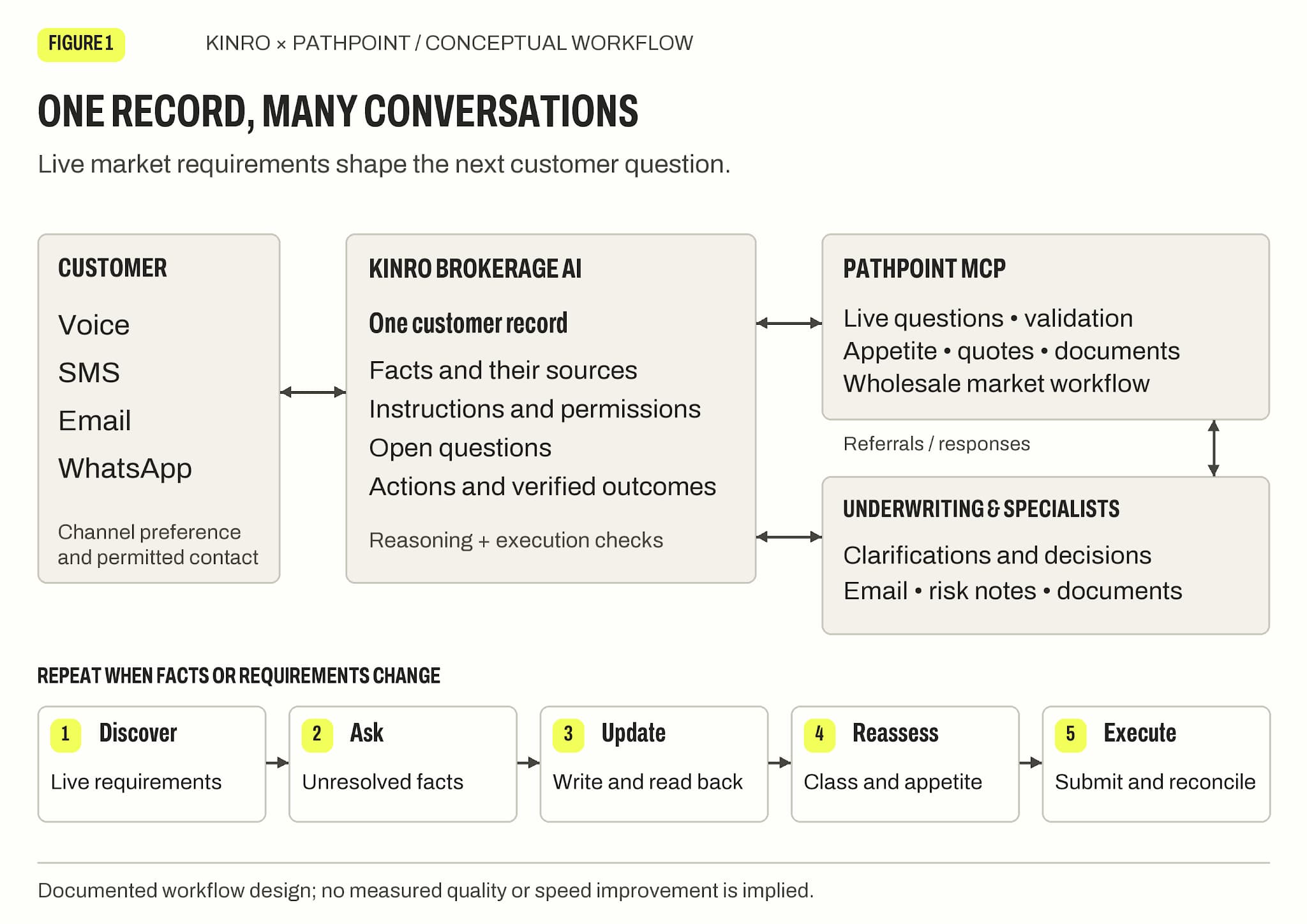
Figure 1. The customer, Kinro, Pathpoint, and underwriting specialists exchange information around one evolving file.
Preserving the risk as the work becomes cheaper
A complicated placement creates a sequence of information problems. What does the business actually do? Which activities matter to this market? What additional evidence is needed? Does a returned quote address the operations, limits, and conditions the customer needs?
Answering those questions takes time even when the policy is small. As placements become more involved, the work can expand through clarification rounds, documents, and specialist review. Kinro’s research on brokerage economics describes the mismatch between the attention customers need and the skilled labor their commissions can support. Its service-cost models are illustrative; they establish no measured E&S savings. [1]
A well-designed AI brokerage can reduce repeated transcription, file reconstruction, and follow-up while retaining the underlying detail. Experts receive a more complete file and a clearer decision to resolve. That is the economic mechanism worth investigating.
Experienced wholesale teams already do much of this well. Relationships, tacit knowledge, and judgment can resolve unfamiliar risks quickly. AI earns its place by improving the information and follow-through around those decisions. The comparison must include the specialist’s remaining work, including any rework the system creates.
Define placement quality before measuring speed
Evaluating AI brokerage requires a clear standard for the work itself. Human and AI-prepared files should be assessed for whether they represent and address the customer’s risk. A complete-looking application, a returned quote, and an issued policy each establish different facts; none settles the entire question of placement quality.
The industry’s own E&O experience gives this concern substance. In a May 2025 Big “I” discussion, Swiss Re and program representatives identify failure to procure sufficient coverage as the leading E&O loss driver and describe added complexity in communicating coverage changes when business moves into E&S. [2]
ELANY’s 2025 annual report adds an operational perspective from E&S itself. Erroneous filings increased with volume, and misuse of coverage codes was the most common filing error. ELANY reports an immediate reduction after simpler codes were introduced. This identifies a useful target for better interfaces and checks; filing errors alone do not establish that coverage was unsuitable. [6]
When a business performs an activity excluded by a product, an application that records only its eligible operations may still return a quote. The important question is whether the insurer accepted the operations and whether the policy’s terms address them. A specialist or E&S placement may be needed; an admitted policy may also be entirely appropriate when it fits.
The concern is forcing the business into an inaccurate description to obtain an apparently workable offer. An AI system should preserve the full description, resolve uncertainty, and seek an appropriate market. It must be evaluated for the same omissions and shortcuts that can undermine human work.
The opportunity is to assess placement quality at file level. A useful next step would be to review operations, contemporaneous applications, policy wording, and underwriting findings against the same standard for human and AI-prepared work. Market-side review would help identify where the workflow adds value and where specialist judgment is still needed. A later E&S placement alone proves no earlier error.
Placement also has a legal route. For nonadmitted insurance, the insured’s home state generally determines the applicable placement requirements, subject to statutory exceptions. [4] California’s export list illustrates why diligent-search obligations and exceptions must be checked against the coverage and current rule. [5] The opportunity is to give agents reviewed, versioned obligations they can act on: collect the evidence, expose what is missing, and send unresolved judgments to a licensed owner. WSIA’s state-by-state charts provide a useful index to the underlying authorities. [7]
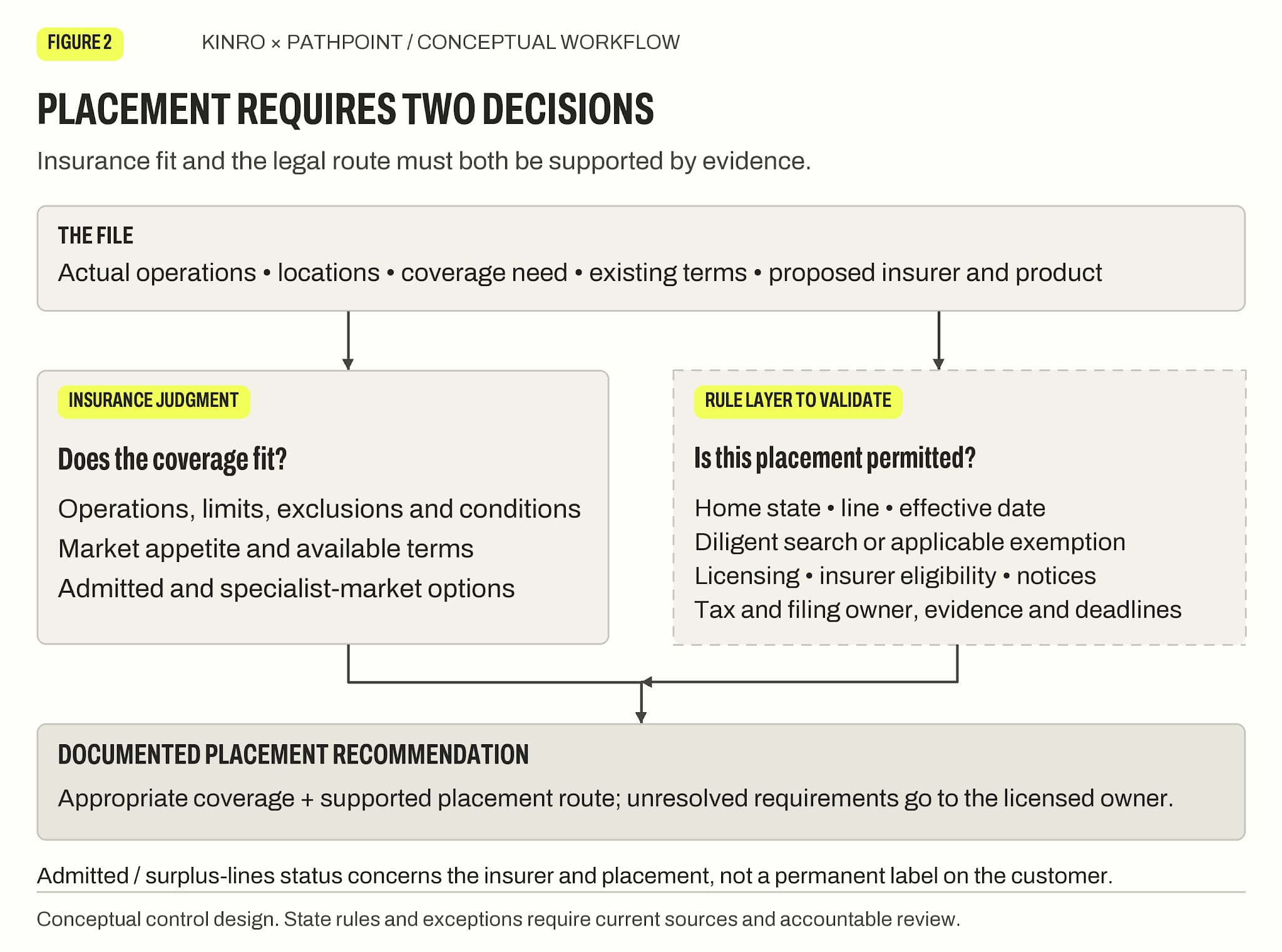
Figure 2. Insurance fit and a supported legal placement route are separate decisions. The state-rule layer is a proposed design.
What an agent-ready workflow changes
Pathpoint’s Model Context Protocol (MCP) interface stands out because an agent can review the state of the insurance work and determine what is required next. Its documented capabilities support a more useful sequence than a fixed form-filling script. [3]
Start with a changed fact. An owner clarifies an operation after intake. The agent should preserve the new disclosure, update the relevant answer, inspect the resulting questions, and determine whether more information is required. Pathpoint’s documentation describes live question discovery, conditional follow-up questions, and readback of stored values. [3]
Then reconsider the placement. A material correction may change classification or appetite. The brokerage should reassess which markets fit and seek a fresh response where earlier terms were based on information that is no longer accurate.
Finally, complete and verify the authorized work. If a submission response is lost, the brokerage needs to establish whether the market already received it before repeating the action. Recording attempts and reconciling uncertain outcomes are distinct from simply retrying a tool. Outstanding documents and bind requirements must remain visible until resolved.
This sequence describes the operating design. The conversation can adapt while the application and transaction remain inspectable. Documented tool capabilities establish what an interface exposes; deployed behavior and operating results require their own verification.
The lesson extends beyond just Pathpoint. Future conversational distribution needs current requirements, explicit state, usable documents, and meaningful actions. The same structure also helps humans using AI tools. MCP supplies a common way to expose capabilities; the quality of those capabilities and their controls determines how useful the connection becomes.
Permission, judgment, and execution need separate tests
Calling the system accountable is useful only if we can explain what it must get right. Three questions need answers:
Is the action permitted? The system needs the right customer, instructions, data access, and market permissions for the action. Customer authorization, brokerage responsibilities, and underwriting authority remain distinct. A credential that opens an account does not settle those questions.
Is the insurance judgment sound? A fully authorized submission can still omit an operation, use an inappropriate classification, or lead to an unsuitable recommendation. Material answers need a traceable basis. Coverage decisions require the relevant policy terms and expertise, including specialist review when the system cannot resolve the issue.
Did execution complete correctly? The brokerage must know what was sent, which application changed, what the market returned, and what remains owed. A record helps reconstruct events; verification and reconciliation establish whether the intended action occurred.
Pathpoint and Kinro have distinct responsibilities within the workflow. An assessment should identify which controls belong to the wholesale platform and which to the brokerage, then distinguish server-enforced permissions, software checks, and model instructions. Each has different limits. A prompt telling an agent to be careful cannot substitute for an authorization boundary.
Scale makes these distinctions more consequential. A shared classification or mapping error can affect many files. Versioned rules, regression tests, monitoring, and the ability to restrict an affected capability are therefore part of the operating standard. Customer documents and tool outputs must remain evidence to evaluate rather than instructions that can change the controls.
These requirements connect E&O discipline to system design. The brokerage must be able to explain its advice, detect unfinished work, investigate failures, and provide any remedy owed. Insurance against E&O exposure complements those responsibilities.
The market should help judge the result
Market-side underwriting review is essential to evaluating the result. An underwriter sees what the originating brokerage may miss: an unclear narrative, an unsupported answer, an operation that changes appetite, or clarification work transferred downstream.
That perspective can answer questions an integration announcement cannot. Do agent-prepared files arrive materially complete? Which corrections remain necessary? Does the process reduce specialist handling time, or merely create submissions faster? Which cases benefit from automation, and which still require experienced relationship-driven work?
The primary result should concern material accuracy, completeness, and the appropriateness of the work performed. Handling effort, time to an actionable quote, and completion belong alongside it. Include unsuccessful cases and unnecessary blocks. Faster intake is a poor outcome if it pushes more work onto the underwriter; higher conversion is a poor outcome if it conceals unsuitable coverage.
A distribution model worth demonstrating
The collaboration connects Kinro’s distribution and customer relationship to Pathpoint’s wholesale workflow and the relevant markets and specialists. Kinro contributes sourcing, engagement, customer context, and brokerage follow-through. Pathpoint contributes market access, live requirements, and specialist placement capability. Issuing markets retain their underwriting and contractual authority.
The relationship continues through signatures, binding, payment, policy delivery, and servicing. Each step needs its own confirmation. A person completes binding in Kinro’s current Pathpoint workflow. Further automation should carry explicit customer authorization and verified prerequisites into the permitted process, then reconcile the market’s final response before coverage is confirmed. This is a development direction, not a claim of autonomous binding today.
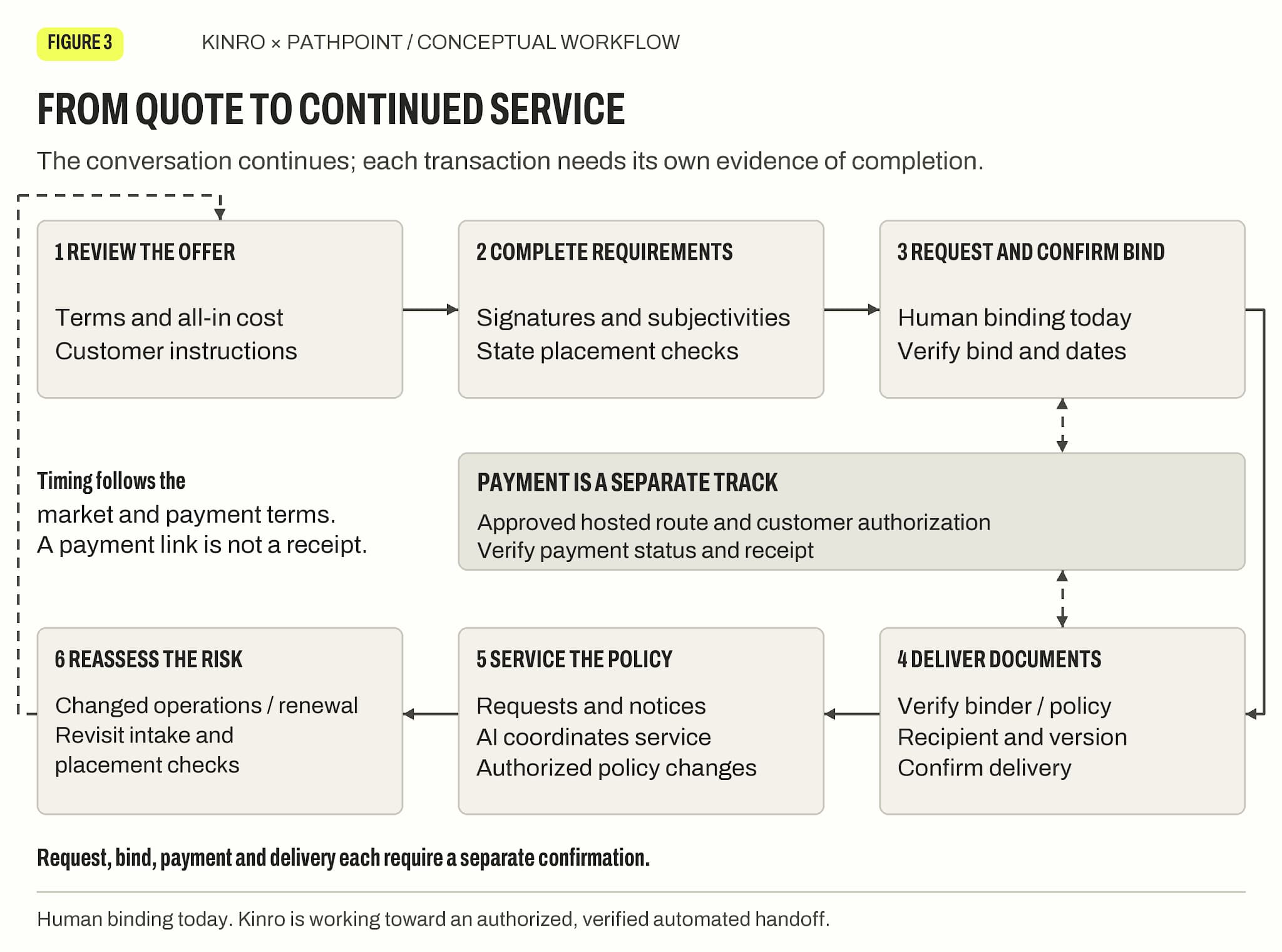
Figure 3. One conversation can coordinate the lifecycle while binding, payment, documents, and policy changes retain distinct controls.
That combination could make specialist expertise available through more channels and across more cases. The standard has to travel with the work: preserve the risk, reach an appropriate decision, execute with permission, and verify the result.
E&S is a useful proving ground because those requirements are difficult to separate. Variation demands adaptation. Policy differences demand judgment. Consequential transactions demand control. A system that can handle that combination well would offer the industry a meaningful model for conversational insurance distribution.
The opportunity for Kinro and Pathpoint is to deepen the connection between customer distribution and E&S placement while making responsibilities and outcomes easier to inspect. A future evaluation could examine file quality and the effort left to specialists. The ambition is practical: help more businesses reach expertise, preserve the risk, and carry the work through to a verified outcome.
References
[3] Pathpoint · MCP workflow documentation.
[4] NRRA · 15 U.S.C. §8202. Regulation of nonadmitted insurance by the insured’s home state.
[5] California Department of Insurance · Export List Hearings.
[6] ELANY · 2025 Annual Report, Operations & Procedures Committee report, pp. 10–11.
Check your options
Before you rely on any coverage, confirm it suits your business with a licensed insurance professional.
Answer a few questions about your business. Eligible businesses can continue to an online application. Otherwise, a licensed Kinro agent follows up with next steps.
Educational information, not a coverage determination. Examples are hypothetical. Policy wording, exclusions and underwriting decide whether coverage applies.